
Tasmea Limited (TEA)
An under‑the‑radar compounding machine, growing EBIT at over 40% CAGR with ROIC above 25%, yet trading at only 13x NTM P/E
Thesis summary
Tasmea is an Australian holding company providing recurring maintenance services under sticky multi-year and inflation-linked contracts. The company is founder-led with management owning 60% of the shares.
While operating in the E&C industry, the business exhibits few of the industry’s usual traits and more characteristics of a quality company. It provides resilient, mission-critical services, with high-switching costs, through a decentralized and well-incentivized model. The financials back this up with 15% EBIT margins, >25% ROIC and 40% EBIT CAGR, which couldn’t be more different than an E&C company.
The investment thesis sums to an aligned and capable management team, acquiring primarily founder-led specialist maintenance businesses at 3-5x EBIT, keeps them decentralized (lowers integration risk), give them support to grow (typically double the business within 3 years) and repeat. The reason they can pay these attractive prices is that they face little competition and enjoy a preferred buyer status as they keep the brand intact and help grow the business. The ability to keep reinvesting capital at such high IRRs, is why management has been able to triple EBIT every 3-year and now targets to double it over the next 3.
Tasmea trades at 13x NTM P/E, which is too cheap for the quality and growth profile. It’s not hard to see a path to at least 20-30% earnings growth. A re-rating would be the cherry on top of the pie and certainly not unreasonable as inferior peers like the Monadelphous Group, that has much lower growth, margins and ROIC, trade at 30x earnings.
Introduction and business overview
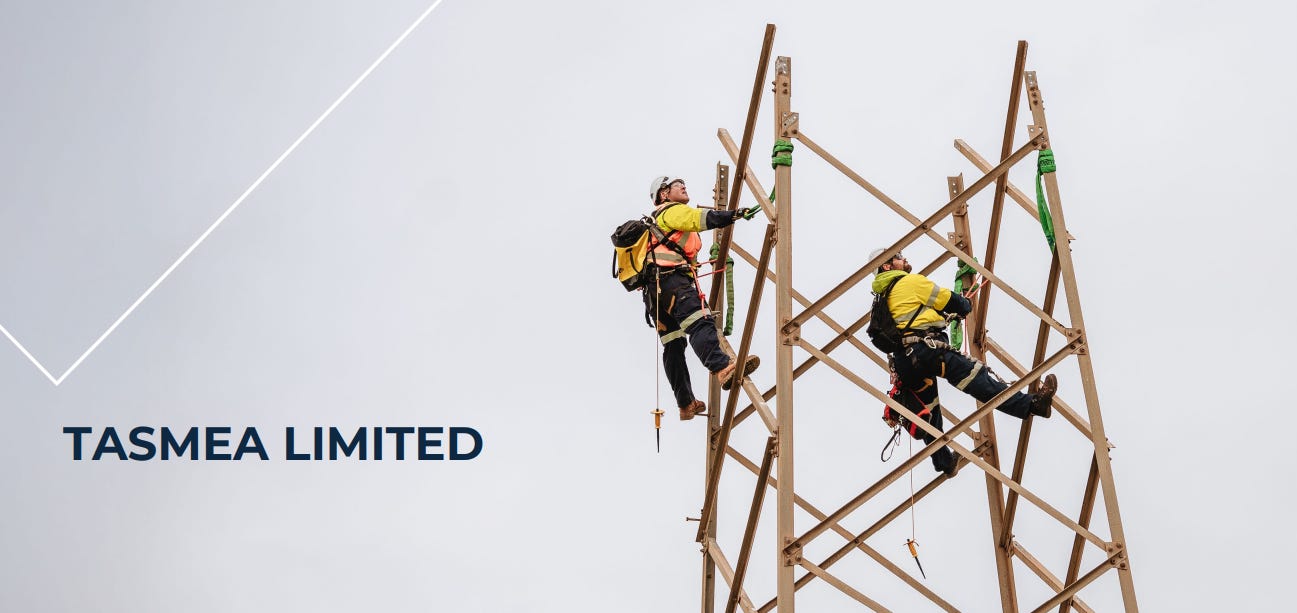
Tasmea Limited is a holding company that provides maintenance and repair services to industrial site owners across Australia. The company performs routine check-ups (scheduled maintenance), fix things when they break (emergency repairs), and make small upgrades to improve plant efficiency (brownfield upgrades). They do this mainly for blue-chip customers across several end-markets with the main ones being iron ore (38% of revenue), energy & renewables (11%), water (9%) and gold (9%). These industrial sites are home to large, fixed assets (think crushers, conveyors, power generators and water management systems) that require billions of dollars in upfront investments. To generate a decent return, plant owners need to maximize up-time.
Because of the harsh environment, high utilization rates, and complex nature of these machines, breakdowns are inevitable. More importantly, breakdowns are expensive and consequences of safety incidents even more so. A conveyor failure can halt the whole process, costing the site owner millions in lost revenue within just a few hours. To minimize downtime, site owners adhere to scheduled maintenance plans and need access to fast and good quality repair services in case of emergencies. Due to the unpredictable nature of repairs and the broad skillset required depending on the problem, site owners generally only have a small crew for basic fixes but outsource the majority. That’s where Tasmea comes in.
Through its 25 subsidiaries, Tasmea offers a variety of services across electrical (cables, sensors, power), mechanical (machine repair), civil (site infrastructure) and water (plumbing). Think of jobs like inspecting and maintaining high-voltage cables, instrumentation, testing circuit breakers, maintaining wastewater and drainage systems and performing shutdowns. Boring stuff, but essential.
These services are largely provided under 3-5 year Master Service Agreements (MSAs) with pre-agreed terms and hourly rates (inflation-linked). The emergency repairs and upgrades fall outside the contract but are relatively easily won as once you have the MSA, your equipment is already on the site, and the workers already have a deep understanding of the plant assets.
Tasmea generates around 70-75% of revenue from above-described maintenance, which is core to the business and central to this thesis. The remainder is roughly split equally between small brownfield construction projects and its recently acquired workforce solutions business (WorkPac).
Why it is a good business
At the surface Tasmea looks like, and even is classified, as just another Engineering & Construction (E&C) company, a label associated with high-risks, boom-and-bust cycles, and a graveyard of bankrupt companies. Tasmea has little of the traits that give E&C its bad reputation. It has low construction exposure (10-15% and only on small brownfield projects), low project concentration risks (revenue spread across >70 MSAs), low risk of cost overruns (paid by the hour with an inflation-linker), low bank guarantees (2% of revenue vs. >20% in the industry) and is relatively insulated from capex cyclicality (depends on production levels of existing plants, not new construction).
The subsidiaries hold the contract with customers with no parent guarantees to the holding company. If for some reason one subsidiary would blow up, Tasmea will lose those related revenues but overall will be fine. Further stability comes from the fact that Tasmea’s subsidiaries largely work with stable blue-chip customers. This all combined, makes Tasmea one of, if not the, lowest risk business models in this space. Rather, Tasmea shares many of the features that most would use to describe a “quality” company: resilient, mission critical services, high-switching costs, decentralized, high insider ownership and a focus on niche markets.
Resilient. Tasmea’s maintenance business is linked to production levels, not new construction/exploration capex. In matter of fact, most of Tasmea’s services flow through their customers P&L as opex, not capex. Since production levels at existing plants are not cyclical, nor are maintenance and repair needs. When commodity prices go down, site owners run their plants at higher production levels as they need more tons to generate the same gross profit to cover their fixed costs. They might defer some shutdowns, but this only leads to more emergency repairs which come at higher margins. Deferring shutdowns is only temporarily as mining operations face strict safety regulations. Moreover, in their largest end-market, iron ore, Australian miners have the world’s lowest break-even costs at $15-20/ton versus the current price of above $100. When in 2014 iron ore prices fell from $150 to $30, Tasman Power (the largest subsidiary) kept growing through it as customers like Rio Tinto only cut exploration, not maintenance capex.
Mission critical services. When a plant shuts down, the costs can run into the millions within hours. Customers care about speed and reliability, not the cheapest price (which is also hard to compare as pricing is on a per-hour basis, not a total price). Tasmea’s repair bill is tiny compared to this. When one of Rio Tinto’s sites was flooded, they only wanted one of Tasmea’s subsidiary to fix it and the CEO of Rio’s Iron Ore division flew the crew in himself on the company’s private jet. This highlights how critical these services are.
High switching costs. Tasmea’s subsidiaries sign multi-year contracts with site owners. Because of the mission critical nature of these services, if you don’t mess up, contracts are generally renewed as switching suppliers brings unnecessary risks. This is also reflected in Tasmea’s 17 years+ average tenure with its top 10 customers and the fact that 94% of revenue comes from repeat customers. The resiliency of steady demand coupled with the high switching costs, makes revenue largely recurring.
Decentralized. Tasmea looks for strong founders/management teams to come along and keep running the business. Tasmea leaves the brand intact, takes care of all the admin/back-office tasks, gives some safety guidelines and makes some customer introductions, but outside of that won’t interfere with the business. Of the 25 subsidiaries, 13-14 still have the initial management team/founders running the company with 10 already outside the 3-year earn-out window. Subsidiary heads are incentivized with earn-outs and performance-based options (contingent on 15% organic EBIT growth for the specific subsidiary).
High insider ownership. The business is founder-led with Stephen Young (Chairman) owning 39% of the shares, Mark Vartuli (CEO) 17% and Jason Pryde (COO) 2%. Not only do they already control close to 60% of the shares, but they also keep reinvesting their dividends back into shares and even buy shares on the open market (most recently in Nov-2025 @ A$4.5 per share). Outside of the C-suite, over 100 employees are part of the LTIP plan, with the same vesting criteria as the subsidiary heads described above.
Niche focus. Unlike general contractors, Tasmea’s subsidiaries focus on specialty services work and on local markets. “Specialty” is defined as when the client requests a specific trade/skillset. If someone with basic work experience can do it, it’s not specialty. Akin to a GP vs. an orthopedic. Most of the workers require specialized training, licenses and supervision to do their work. Tasmea’s specialty focus is reflected in its financials, with EBIT margins of 15% compared to 3–5% for Tier 1 general contractors like Monadelphous, SRG Global, and Downer Group. In addition, Tasmea generates 3–4x more operating income per employee than their Tier 1 peers. Competition is mostly with smaller local players as the the Tier 1’s focus mainly on large, centralized projects and lack the local teams to compete. The size of Tasmea’s typical contracts with MSAs on average being in the single-digit millions, isn’t worthwhile for these larger groups who typically secure multi-hundred million contracts.
Tasmea’s subsidiaries enjoy strong reputations with industry leading safety rates with over 12 years without a lost-time injury (coming down to 10M+ hours vs. industry-wide 8.4 lost-time injuries per million hours worked). They are not the cheapest on a per hour basis but position themselves as a quality provider. They have lost bids occasionally to a cheaper quoted provider, but the customer often came back to Tasmea’s subsidiaries after the other failed to deliver.
While this is far from an exciting industry, it’s a very lucrative one. Tasmea has been growing revenue and EBIT at 30% and 42% CAGR over the past 5 years. Returns on capital are excellent at over 25%, which is even more impressive given the company is a frequent acquirer.
Investment thesis & valuation
If I must boil down the investment thesis to one thing it would be an aligned management team that understands capital allocation. The industry and business itself are decent as per above but it’s the acquisition strategy that allows management to reinvest capital at >25% ROIC and compound earnings historically at >40% per annum.
Management looks for businesses that focus primarily on specialized maintenance services, in growing industries (i.e. iron ore, gold, but not coal), have strong operators at the helm (preferably founders) and with strong customer relationships (which they can tell by looking at the type of customers and how the MSAs are structured). They also need to understand why the owners are selling, otherwise they pass. Typical reasons include one of the partners stepping down and the other can’t buy him out, lack of capital for required growth, a desire to de-risk by cashing out and retirement (less preferred as this means the founder steps down).
Importantly, they don’t integrate these businesses, which significantly lowers execution risks. They buy well-run owner-operated business and keep them decentralized. The only involvement is centralizing the administrative stuff (payroll, HR, legal, insurance, accounting), provide financing for growth, safety guidelines and make introductions to customers to boost growth. Synergies come from the revenue side, not costs. When management buys companies they write a business plan on how they are going to double revenue within 3 years.
Tasmea pays around 3-5x EBIT (excl. synergies), of which 50% is paid upfront in cash, 25% upfront in Tasmea shares (to align incentives) and 25% in earn-outs over a 3 to 4-year period. The earn-out is contingent on achieving a 15% organic EBIT growth CAGR. Equity is typically issued at a premium versus the current trading.
The reason Tasmea can get away with these attractive prices is predominantly because of the size and remote location of these businesses. They typically pay between A$10-50M for deals, which is too large for owner-operators and too small and too remote for PE. The Tier 1 groups are not organizationally set up to follow such a strategy and for a new holding company or PE to try and replicate this from scratch is tough (WorkPac tried this around 2020 with no success). Aside from this, Tasmea built a reputation as a preferred buyer. They leave the brand intact, take good care of the people (no firing post-closing), take care of all the boring stuff, help the business get to the next level by providing resources, help you win projects you otherwise never were able to get and above-all have a track record in doing all of this.
Management sources these deals directly, with most of them coming from referrals from existing subsidiaries’ heads who sold to Tasmea. They are continuously talking to CEOs to nurture relationships. They get around 100 leads per year, of which 10 reach the negotiating table and 3-4 are closed. Management is very optimistic about the pipeline for at least the next 5-10 years. In management’s words: “we see more opportunities than we have capital”.
I can’t stress enough the importance of these acquisitions, as they are also the main driver of organic growth by executing on the revenue synergies post-closing. If we assume that management allocates all excess FCF to acquisitions at 5x EBIT, earnings can easily compound at >20% for the next 5 years. This is probably conservative as I don’t assume any equity issuance (typically 1/3 of the consideration and highly accretive, using 10-11x EV/EBIT to buy assets at 5x) nor any further balance sheet leverage (keep it constant at t 1.1x ND/EBITDA vs. 0.5x currently). Either way a >20% earnings growth + close to 3% dividend yield is already attractive. Management internally targets to double EBIT every 3 year. While this sounds ambitious, in both the two prior 3-year cycles (FY19-22 and FY22-25), they more than tripled it.
A re-rating could boost the IRR higher. Tasmea now trades at 13x NTM P/E, which is not only too low given the growth profile, but also compared to peers. Mader Group trades at 24x NTM P/E and Monadelphous Group at 30x. Sure, Tasmea relies more on inorganic growth, which warrants a discount, but considering higher margins, higher total growth and a higher ROIC, does this discrepancy make sense? Tasmea’s forward multiple is also understated as sell-side doesn’t model M&A. For example, the recent WorkPac deal added 10% to earnings.
I see two catalyst which could crystalize the re-rating. First, ASX300 index inclusion in March 2026. From what I’m told they already fulfil the liquidity threshold and now need to be ranked at least #274 in terms of market cap to get included. They are currently trading on and off around this position. If they were to be included, it would open the door to passive index buyers and institutional investors. Second, Tasmea has a relatively new business model and needs time to build a public track record. If the performance keeps on strong, the multiple should follow.
Why this opportunity exists
Misunderstood. Most look at this company and see another cyclical E&C company, which as described is far from reality. Combine the label serial acquirer (something Australian investors are typically not fund off) and this seems much riskier than it truly is.
Perceived customer concentration. The top 10 customers account for 50% of revenue with the largest, Rio Tinto, being 25%. This revenue is not linked to just one contract. For Rio Tinto, the revenue is spread over 7+ subsidiaries, 8+ contracts, and 20+ sites. These contracts are independent from another.
The “E&A Stigma”. Tasmea was previously known as E&A Limited, a company that got into trouble by moving into large lump sum construction projects, working with project planners (one who went bankrupt), legal disputes and project delays. The shares became depressed and management took the company private. These events caused management to make crucial changes such as moving away from construction and towards maintenance, minimize the number of project-based work and if so, only small projects (no subsidiary can tender for projects over A$5M without approval), only work directly for the asset owner and reduce bank guarantees. It seems that management has learned its lesson the hard way and are determined not to make it again. A view further enhanced by the 60% insider ownership.
Size and Liquidity. Tasmea is a relatively small company A$1B market cap with only 40% float and a limited public track record float (IPO in 2024). They are not included in the ASX 300 (yet), preventing most institutional funds from buying it.
WorkPac acquisition. In November 2025, Tasmea bought WorkPac, Australia’s largest privately owned workforce solutions company that recruits mainly blue-collar workers in industrial, construction, and engineering sectors. The rationale of the deal was to fix the industry’s largest issue, labor shortages, giving Tasmea access to additional workers when needed. Subsidiaries are happy with the deal as it helps them take on more projects (in the past some were declined due to lack of labor), while customers now have a stronger delivery assurance. Tasmea paid 3.4x EBIT (excl. synergies), with synergies having the potential to lower it below 3x through office consolidation, lower flexible labor spending, and cross-selling. Despite the logic of the deal, Tasmea’s shares fell 20% in the following weeks as some institutional investors who didn’t like WorkPac sold and others feared it signaled that the pipeline for the traditional deals is drying up. On the former, at the price Tasmea paid, WorkPac can even decline and it still represents a good IRR. On the latter, management assured me several times over that the pipeline of deals is rather increasing.
The biggest risk I see is that this isn’t such a good company as they are preaching and the financials are showing. It may be more similar to E&A Limited in the sense that their business is more construction related than it appears, exposed to claims and disputes (which proved painful for E&A), the services provided are not specialized and the reason they can pay these attractive prices for these acquisitions is because these are bad and cyclical companies.
Excellent write-up.
Great write up! TEA is clearly undervalued even with a general discount applied due to not being a general operating services/maintenance business. Agree as well with the potential catalysts, especially the ASX300 inclusion.
Do you have perspective or thoughts into the recievables growth YoY for TEA? Trade receivables % growth was well ahead of rev for 2025 (I believe aroudn 70% v 37%) - noted TEA completed roughly $150m in acquisitions for 2025, so these acquired businesses accounts go onto the books, I would assume most of the AR growth would be applicable to the $80m acquisition of FEG group. Do you see this as an area of concern/investigation given TEA's operating and acquiring performance to date?